Recently Published ...
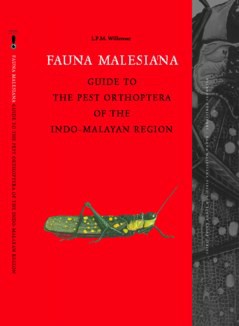
Fauna Malesiana Guide to the Pest Orthoptera
of the Indo-Malayan Region
Willemse, L.P.M.
2001, 160pp., 166 (16 col.) figs., hardbound
ISBN 90-5782-075-7
NLG 80.00 / US$ 40.00
From the preface:
Fauna Malesiana aims to diffuse knowledge of the zoodiversity of Southeast
Asia, and to make it accessible to both expert and layman. A core activity
of the Foundation is the production of Handbooks and Field and Study Guides.
Field and Study Guides are identification guides with various possible formats,
ranging from limited monograph-type guides to a little known group, intended
to raise general awareness, to books of a more practical nature, aiding professionals
in the applied sciences. The present guide is an example of the latter type.
Several studies dealing with various pest insects in the Indo-Malayan region
have been published in the past, including Kalshoven’s monumental The
Pests of Crops in Indonesia. The most important pests were either described
in relation to a particular crop or to a specific geographical area. These
publications were often expensive and difficult to obtain, which formed an
obstacle for those who most needed them: people working in the agricultural
sector in the region. Our principle goal with this field guide is to make
the available knowledge about Indo-Malayan pest Orthoptera (including the
lesser known species) accessible to the people who may benefit the most from
this information.
Throughout the production of this Field Guide, our imaginary audience consisted
of professionals, such as agriculturists, agricultural officers, economic
entomologists, extension workers, rural development officers, but also students
of agriculture, agronomy, general entomology, forestry, etc. We hope that
this field guide will prove to be useful, both for people who know about agricultural
problems and are interested in identifying the possible orthopteran culprits,
as much as for people who know about orthopterans and are interested in the
problems they may cause.
From the introduction
This guide aims to facilitate the identification of grasshoppers, locusts,
bushcrickets and crickets (Orthoptera) that are known or suspected to act
as pests in the Indo-Malayan region, and to summarize published information
on their distribution, biology, ecology, food plants and economic importance.
In principle, all species of Orthoptera are included that have been mentioned
in the literature as pest species in the Indo-Malayan region (Malaysia, Singapore,
Indonesia, the Philippines and Papua New Guinea). A few species, like Chrotogonus
spp. and Tridactylus spp. on Brassica spp., the crickets Oecanthus spp. on
tobacco, Gryllus bimaculatus on coffee and sugar cane in the Philippines and
Erucius apicalis on cacao in Malaysia, have been mentioned in the literature
without any further notice. Because of this lack of information they have
been excluded here.
An illustrated key is provided for the identification of the species and species
groups treated in this guide. As far as possible, the key uses characters
that are discernable without a magnifying glass. Inevitably, in some cases
characters had to be used that require the use of a hand-lens or stereo-microscope.
For some species groups a key to the level of species is lacking since identification
would require the examination of male and female genitalia. Readers interested
in the identification of these species are referred to the specialized taxonomic
literature.
In the systematic section, families are characterized morphologically, and
general remarks on their distribution, species numbers worldwide, and biology
are provided. Information for each species (or species group) includes, as
far as known, notes on nomenclature, morphology, distribution, life cycle,
ecology and behaviour, food plants and economic importance.
From the contents
Introduction/ Characteristics of Orthoptera/ Illustrated key
Species descriptions
-Suborder Caelifera
-Family Tetrigidae
-Family Pyrgomorphidae
Aularches miliaris, Desmopterella spp. , Tagasta marginella , Atractomorpha
spp.
-Family Acrididae , Subfamily Oxyinae Oxya spp.,
Caryanda diminuta , Gesonula mundata, Quilta mitrata,
-Subfamily Hemiacridinae
Spathosternum prasiniferum
-Subfamily Coptacridinae,
Apalacris varicornis, Traulia spp.
-Subfamily Catantopinae
Stenocatantops spp., Xenocatantops humilis
-Subfamily Cyrtacanthacridinae
Valanga spp. , Melicodes tenebrosa, Patanga spp., Austracris guttulosa, Cyrtacanthacris
tatarica, Chondracris rosea
-Subfamily Acridinae
Acrida spp., Phlaeoba spp., Gonista bicolor, Aiolopus thalassinus, Pternoscirta
caliginosa, Heteropternis spp., Gastrimargus marmoratus
Locusta migratoria, Trilophidia annulata,
-Suborder Ensifera
-Family Tettigoniidae
-Subfamily Phaneropterinae
Phaneroptera spp., Holochlora pygmaea , Ducetia spp., Elimaea chloris
-Subfamily Conocephalinae
Conocephalus spp., Euconocephalus varius
-Subfamily Pseudophyllinae
Chloracris prasina
Subfamily Mecopodinae
Mecopoda elongata, ‘Sexavae’ , Segestidea spp., Segestes decoratus,
Sexava spp.
Family Gryllidae
Subfamily Brachytrupinae
Tarbinskiellus portentosus
The Central Amazon floodplain: actual use and options for a sustainable management
Edited by W.J. Junk, J.J.
Ohly, M.T.F. Piedade & M.G.M. Soares
2001, xxvi and 590 pages with 59 photographs, 57 linedrawings and
114 tables.
Hardbound.
ISBN 90-5782-074-9
Dutch Guilders 296.00/US$ 148.00
Sustainable management of wetlands is a subject of increasing public interest, because loss of wetlands and related biodiversity is reaching alarming dimensions worldwide. Large pristine wtlands still exist in tropical South America. However during the last decades there has been an increasing pressure to utilize them. They are considered valuable because they provide land resources for agriculture and animal ranching and offer also fish, forest products, water, transport facilities, possibilities for tourism and other benefits. Lack of knowledge and conflicts of interest often lead to inadequate use of the resources and sometimes to serious damage of the wetland systems.
The Amazon River floodplain, locally called várzea, is of specific interest for regional development because of its large size, fertile soils, abundant fishery resources, and valuable timber. Traditional small-scale subsistence farmers are facing increasing pressure from large-scale cattle and buffalo ranchers. There are plans to install large-scale paddy rice and soy bean plantations in the floodplain with dramatic consequences for the local population and the ecosystem integrity.
The book presents in 24 chapters a coherent analysis of the ecological situation, the history of land occupation, the different forms of resource utilization, the socio-economic situation of the population, and the ecological threats of human activities on the Amazon floodplain. Cost-benefit analyses of different forms of land use are compared with market demands and environmental impacts. Conflicts of interest between different stake holders (e.g., smallholders and ranchers, professional and subsistence fishermen) are described. A chapter about environmental legislation and its deficiencies points to the need for additional regulations to avoid further conflicts of interest and negative impact of human activities on the ecosystem.
It is shown that despite a relatively high ferility, the potential of the várzea for agriculture and animal farming is limited by ecological constraints related to the flood pulse. Three concepts are presented that, together, will allow the sustainable management of the natural resources. The Flood Pulse Concept describes the structure and function of the system. It is the scientific basis for the Concept of Multiple Use that recommends the optimization of the use of all resources instead of the maximization of the use of a single resource. The participation of the local population in resource management is fostered by the Concept of Decentralized and Participative Management that will also stimulate the acceptance of regulations for the protection of habitat and species diversity.
This is the first book that
deals with sustainable management of a tropical wetland with
coherent and new data sets in an interdisciplinary approach, along
with a strong conceptional background. Therefore, it is not only
of interest of the sustainable management of the Amazon Rover
floodplain, but it serves as a conceptional basis for the
sustainable management in general.
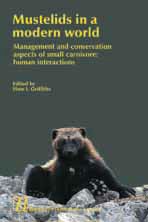 Mustelids
in a modern world
Mustelids
in a modern world
Management
and conservation aspects of small carnivore: human
interactions
Edited by Huw I.
Griffiths
2000, x and 342 pages with 76 figures and 35 tables.
Paperbound.
ISBN 90-5782-066-8
Dutch Guilders 180.00/US$ 90.00
Preface
The mustelids - otters, badgers, martens, weasels and their allies
- make up one of the most diverse families of modern-day
carnivores. However, unlike many other carnivore families,
mustelids have rarely attracted the attention, interest or
sympathy of the public. Human attitudes to mustelids are fraught
with contradictions. Almost every school child knows of the highly
photogenic otters and, in parts of western Europe, badger
conservation and welfare evokes emotions that often seem to verge
on the fanatical. In contrast, many other people view mustelids
rather more negatively. Gamekeepers and hunters may see them as
killers of ground-nesting gamebirds and their chicks, farmers
often perceive them as pests (menaces to crops or livestock), and
public health officials worry about plague, rabies and bovine
tuberculosis. To add to the confusion, many mustelids are
economically significant as furbearers, so adding all the
controversy associated with the fur industry.
Despite these diverse views, mustelids are the most common
predatory mammals in many northern-hemisphere ecosystems.
Furthermore, like all other predatory species, they exist under
increasing pressure in a world where human population and
infrastructure permeate even the wildernesses. So, even in a
society with a growing conservation ethic, mustelids are often
hunted or persecuted, and their habitats are being altered,
fragmented and eroded (as are those of their prey species).
Survival in the modern, human-dominated world seems a challenging
prospect.
The present volume arose out of informal discussions held around
the mustelid session of the Euro-American Mammal Congress in
Santiago de Compostela (Spain) in July 1998. This gave workers
from many countries and a broad range of disciplines the chance to
come together, and to compare experiences and viewpoints. This was
a relatively rare occasion as mustelid specialists tend align with
one or other of the two relevant IUCN groups (Small Carnivores,
Otters). As few technical or popular works deal with mustelids, it
was felt that it was timely to take a wider view, and to examine
themes relevant to the conservation of the group as a whole. The
result is the present volume; a selection of invited thematic
essays and research papers that aims to provide "snap shots" which
explore some aspects of how these creatures live in
human-dominated landscapes. We cannot, of course deal with every
problem faced by every species, but I hope that the result does
illustrate the major issues, and provides some insights as to how
these magnificent animals can survive in the new millennium.
Many people have helped in the realisation of this project, most
particularly the authors themselves. We would also like to thank
Dr. Santiago Reig and the organisers of the Euro-American
Congress, the European Mammal Society (SEM), Sociedad
Española para la Conservacion y Estudio de los Mamiferos,
the American Society of Mammalogists and the authorities of Xunta
de Galicia and Universidade de Santiago de Compostela. I would
also like to thank the many colleagues who took the time and
trouble to critically review chapters for this book: Dan Harrison
(Orono, USA), Lorenz Hauser, David Watts and Graham Ferrier (Hull,
England), Tim Roper (Brighton, England), Audrey Magoun (Fairbanks,
Alaska), Derek Yalden (Manchester, England), Martyn Gorman
(Aberdeen, Scotland), Andrew Kitchener (Edinburgh, Scotland), Don
Jefferies (Peterborough, England), Vivian Banci (Maple Ridge,
Canada), Hans Kruuk (Aboyne, Scotland), Yves Garant
(Trois-Rivières, Canada), Paddy Sleeman (Cork, Irish
Republic), Carolyn King (Waikato, New Zealand), Johnny Birks
(Malvern, England), Boris Kry?tufek (Ljubljana, Slovenia), Angela
Glatston (Rotterdam, the Netherlands), Piero Genovesi (Ozzana
Emiliana, Italy), Danielle Schreve (London, England) and Alan
Turner (Liverpool, England). Thanks also to Laura Hindle and the
Hull "Mammal Conservation" students for their efforts on my
behalf.
Especial thanks are due to Keith Scurr who made a stirling effort
with the artwork, for which I (and the individual authors) am
truly grateful, and to Jane Reed for cups of tea and for
proof-reading beyond the call of duty!
Contents
Preface vii
Authors addresses ix
1.
Conservation of Scandinavian wolverines in ecological and
political landscapes
Arild Landa John D.C. Linnell, Mats Lindén, Jon E. Swenson,
Eivin Røskaft & Arne Moksnes
2. A
comparison of the management of stoats and weasels in Great
Britain and New Zealand
Robbie A. McDonald & Elaine C. Murphy
3. The
conservation status of New World mustelids
Steven W. Buskirk
4. The
impact of human activities on North American mustelids
Gilbert Proulx
5.
Management and conservation of mustelids in Ontario and eastern
Canada
Jean-François Robitaille
6.
Black-footed ferrets: recovering an endangered species in an
endangered habitat
Astrid Vargas, Pete Gober, Mike Lockhart & Paul
Marinari
7.
American river otters, Lontra canadensis, and humans: occurrence
in a coastal urban habitat and reaction to increased levels of
disturbance
Peter Giere & Don S. Eastman
8.
Prehistoric mustelid exploitation: an overview
Ruth Charles
9. The
recovery of the polecat, Mustela putorius, in Britain
Johnny D.S. Birks
10.
Conservation implications of hybridisation between polecats,
ferrets and European mink (Mustela spp.)
Angus Davison, Johnny D.S. Birks, Tiit Maran, David W. Macdonald,
Vadim E. Sidorovich & Huw I. Griffiths
11.
Otters recovering in man-made habitats in central Europe
Andreas Kranz & Ales Toman
12. The
application of Geographic Information Systems and computer
modelling to mustelid research
Mary C. Gough & Steve P. Rushton
13. A
spatial analysis of mustelid distributions in northern Italy
Lorenzo Fornasari, Luciano Bani, Ivan Bonfanti, Elisabetta de
Carli & Renato Massa
14.
Monitoring the very rare: pine marten populations in England and
Wales
John E. Messenger & Johnny D.S. Birks
15.
Factors influencing otter, Lutra lutra, numbers and distribution
on part of the Blackwater catchment (Ireland)
Paola Ottino & Paul Giller
16.
Wildlife management and scientific research: a retrospective
evaluation of two badger removal operations for the control of
bovine tuberculosis
Frank A.M. Tuyttens, Lucy Barron, Lucy M. Rogers, Peter J.
Mallinson & David W. Macdonald
17.
Changes in badger, Meles meles, social organisation in response to
increasing population density at Woodchester Park, south-west
England
Lucy M. Rogers, Richard J. Delahay, Tim D. Hounsome & Chris L.
Cheeseman
18.
Mustelids in the Balkans - small carnivores in the European
biodiversity hot-spot
Boris Kryztufek
19. The
on-going decline of riparian mustelids (European mink, Mustela
lutreola, polecat, Mustela putorius, and stoat, Mustelaerminea) in
eastern Europe: a review of the results to date and an
hypothesis.
Vadim E. Sidorovich
20. The
marbled polecat, Vormela peregusna (Güldenstaedt, 1770), in
FR Yugoslavia an elsewhere
Miroljub Milenkoviç, Milan Paunoviç, Helen E. Abel
& Huw I. Griffiths
21. The
status and conservation of Taiwan's mustelids
Liang-Kong Lin
Index
to scientific names, Subject index
Phytoplankton
Dynamics in the North American Great Lakes
Volume
2
Lakes Superior and Michigan, North Channel, Georgian Bay and Lake
Huron
Mohiuddin Munawar
& Iftekhar Fatima Munawar
2000, xx and 254 pages with 92 figures and 30 tables.
Hardbound.
ISBN 90-5782-032-3
Dutch Guilders 176.00/US$ 88.00
From
the preface
A dream which we have nurtured for a long time has been realized.
With this volume, the phycology of the North American Great Lakes
has been brought into the new millenium. The current volume
focuses on the Upper Great Lakes, that is, Lakes Superior and
Michigan, the North Channel, Georgian Bay, and Lake Huron. It also
includes a chapter devoted to the integration, summarization, and
synthesis of major findings in all of the North American Great
Lakes encompassing both books. Furthermore, an attempt has been
made in the summary/synthesis chapter to discuss the current and
future status of food-web research in the Great Lakes. In addition
to a taxonomic index, volume 2 also includes a comprehensive and
professionally prepared subject index for both the volumes. The
detailed background of the initiation and completion of the Great
Lakes phycological research on which these two books are based is
provided in the preface to volume 1 (Munawar & Munawar, 1996),
reprinted and included in this book.
For the convenience and benefit of interested readers, a selected
list of references is provided below. These works provide the
background and complementary physical, chemical, biological and
limnological information essential for a holistic assessment of
the structure and function of the phytoplankton of the North
American Great Lakes. We hope that our long-term effort in the
production of these volumes will enhance the understanding and
knowledge of the trophic structure of the Great Lakes, especially
the often neglected but essential microbial food web, and as well,
will be beneficial to those who study, manage, and conserve the
Great Lakes.
Table of Contents
Dedication
Preface (from Volume 1)
Preface
Salutation by R.A. Vollenweider
Foreword by C.S. Reynolds
Acknowledgement of the Copyright
Chapter 1. Lake Superior: Phytoplankton Composition, Parameters, and Ecological Implications
Chapter 2. Lake Michigan: Phytoplankton Composition, Parameters, and Ecological Implications
Chapter 3. North Channel: Phytoplankton Composition, Parameters, and Ecological Implications
Chapter 4. Georgian Bay: Phytoplankton Composition, Parameters, and Ecological Implications
Chapter 5. Lake Huron: Phytoplankton Composition, Parameters, and Ecological Implications
Chapter 6. Phytoplankton Dynamics in the North American Great Lakes: Synthesis and Summary
Taxonomic Index
Subject
Index
 New
approaches to river management
New
approaches to river management
A.J.M. Smits,
P.H. Nienhuis & R.S.E.W. Leuven (Eds.)
2000, x and 356 pages with 79 figures and 36 tables., paper.
ISBN: 90-5782-058-7 Dutch Guilders 200.00/US$
100.00
An international conference on
new approaches to river management was held in September 1998,
organised by the University of Nijmegen. The present book is the
result of this timely congress, and it fills an open niche in
river science information. It contributes to the dissemination of
world-wide experience with regard to comprehensive management
planning of river basins, and focuses on new approaches to promote
sustainable management. The evolution from integrated approaches
to sustainable river basin management is highlighted. The book
intends to increase public awareness of the necessity of
sustainable river basin management. Examples and case studies are
taken from all over the world, i.e., Europe, North and South
America, and South East Asia.
The peer reviewed and amply documented chapters written by 40
authors cover three themes, viz.: (1) developments in integrated
river basin management: applications and lessons learnt; (2)
participation of new stakeholders in river basin management, and
(3) new methodologies and instruments in sustainable river basin
management.
The book covers current issues in river management, such as river
regulation, flooding, pollution, habitat destruction and
fragmentation, water resource allocation and water-related
conflicts. In this context the document should be regarded as a
substantial contribution to the underpinning of the upcoming
European Water Framework Directive.
Market: water authorities, policy makers, non-governmental
organisations, scientists, students and all those who are involved
in river basin management.
Contents
Preface
Opening addresses
New approaches to river management: integration of knowledge and
ideas,
C.W. Stortenbeker; The value of sustainable river management, His
Royal Highness Prince Willem-Alexander of Orange
Introduction
New approaches to river management: general introduction, A.J.M.
Smits, P.H. Nienhuis & R.S.E.W. Leuven
Developments in integrated river basin management: applications
and lessons learnt
River management along the Rhine: a retrospective view, H. Havinga
& A.J.M. Smits; Strongly polluted deposits in the Meuse river
floodplain and their effects on river management, C.J.J. Schouten,
M.C. Rang, B.A. de Hamer & H.R.A. van Hout; Three centuries of
river management along the Mississippi river: engineering and
hydrological aspects, G.E. Galloway Jr.; Elbe, Odra, and Vistula:
reference rivers for the restoration of biodiversity and habitat
quality, P.H. Nienhuis, J.C. Chojnacki, O. Harms, W. Majewski, W.
Parzonka & T. Prus; Management of the Mekong river basin, N.N.
Quang; Ecological basis for the management of the Pantanal - upper
Paraguay river basin, C.J. da Silva
Participation of new stakeholders in river basin management
New approaches to river management in the United States of
America, C.E. Hunt; Partners in wetland conservation and
development: strategic environmental analysis for the Ukrainian
Danube delta, J.C.J. van Wetten; Bridging the communication gap in
river management, G.J. Matthews & M. Horner; Eco-centric
cost-benefit analysis for hydraulic engineering in river basins,
J.J. Bouma & H.L.F. Saeijs; "Fisquality", a proposal for a tax
bonus to improve hydro-ecological resilience of river catchments,
A. Corporaal
New methodologies and instruments in sustainable river basin
management
Is there a future for big dams?, R.J.A. Goodland; Following a
diversified strategy to achieve the sustainable use of the Mekong
river basin,C.E. Hunt; Technical support of public decisions to
restore floodplain ecosystems: a status report on the Illinois
river project, USA, R.E. Sparks, J.B. Braden, M. Demissie, P.
Mitra, D.W. Schneider, D.C. White & R. Xia; A policy analysis
for the upper Danube river section in Hungary, J. Leentvaar &
P.C.G. Glas; New concepts in river and water management in the
Rhine river basin: how to live with the unexpected?, A.J.M. Smits,
H. Havinga & E.C.L. Marteijn; Multi-level approach to flood
control in the Dutch part of the river Meuse, W. van Leussen, G.
Kater & P. van Meel; Using natural cleaning processes in the
river ecosystem: a new approach to environmental river management.
Does natural attenuation out balance the risks of organic and
inorganic contaminants in a river ecosystem?, H.J.P. Eijsackers
& P. Doelman
Discussion
From integrated approaches to sustainable river basin management,
R.S.E.W. Leuven, A.J.M. Smits & P.H. Nienhuis
Index of authors, Subject index
 Ecology,
biogeography and management of Pinus halepensis and P.
Brutia forest ecosystems in the Mediterranean
basin
Ecology,
biogeography and management of Pinus halepensis and P.
Brutia forest ecosystems in the Mediterranean
basin
Gidi Ne'eman & Louis
Trabaud
2000, xii and 412 pages with 97 figures and 45 tables,
hardbound.
ISBN 90-5782-055-2 Dutch Guilders 240.00/US$ 120.00
Contents
A. Taxonomy and autoecology
1. P. Quézel, Taxonomy and biogeography of Mediterranean
pine species (Pinus halepensis and P. brutia). 2. G.
Schiller, Inter- and intra-specific genetic diversity of P.
halepensis Mill. and P. brutia Ten. 3. C.A. Thanos, Ecophysiology
of germination in P. halepensis and P. brutia. 4. G.
Schiller, Water stress and ecophysiology in P. halepensis
and P. brutia. 5. S. Lev-Yadun, Wood structure and the
ecology of annual growth ring formation in Pinus halepensis
and P. brutia. 6. C.A. Thanos and E.N. Daskalakou,
Reproduction in Pinus halepensis and P. brutia. 7.
A. Shmida, G. Ne'eman, S. Goubitz and S. Lev-Yadun, Sexual
allocation and gender segregation in Pinus halepensis and
P. brutia. 8. R. Nathan and G. Ne'eman, Seronity, seed
dispersal and seed predation in P. halepensis. 9. M.
Weinstein-Evron and S. Lev-Yadun, Paleoecology of Pinus
halepensis in Israel in the light of palynological and
archeological data. 10. D. Richardson, Mediterranean pines as
invader species in the southern hemisphere.
B. Pine forest ecosystem
11. P. Kutiel, Plant composition and plant species diversity in
P. halepensis forests. 12. M.A. Zavala, Aleppo pine stand
dynamics in relation to water balance and disturbance: a
mechanistic model. 13. I. Izhaki and G. Ne'eman, Soil seed bank in
P. halepensis natural forests. 14. M. Arianoutsou and C.
Radea, Litter production and decomposition in P. halepensis
forests. 15. M. Honrubia, Mycorrhyzas in P. halepensis
Miller. 16. M. Broza, Soil arthropodes in P. halepensis
forests. 17. Z. Mendel, The phytophagous insect fauna of Pinus
halepensis and P. brutia forests in the Mediterranean.
18. I. Izhaki, Passerine bird communities in Mediterranean pine
forests. 19. A. Haim, Mammal fauna in P. halepensis
forests.
C. Fire ecology
20. L. Trabaud, Post-fire regeneration of P. halepensis
forests in the west Mediterranean. 21. M. Arianoutsou and G.
Ne'eman, Post-fire regeneration of natural P. halepensis
forests in the east Mediterranean. 22. C.A. Thanos and M.A.
Doussi, Post-fire regeneration of P. brutia forests. 23. G.
Ne'eman, The effect of burned pine trees on post-fire
regeneration. 24. G. Ne'eman and A. Perevolotzki, Fire management
of natural P. halepensis forests in east Mediterranean
basin. 25. V. Leone, A. Saracino, L. Trabaud and R. Velez, Fire
prevention and management policies in west Mediterranean pine
forests.
D. Afforestation and anthropogenic impacts
26. M. Etienne, Pine agroforestry in the west Mediterranean basin.
27. C.N. Tsiouvaras, Silvopastoral management of Pinus
halepensis and P. brutia forests in Greece. 28. O.
Boneh, Management of planted pine forests in Israel: past, present
and future. 29. J.D. Barnes, D. Velissariou, P. Dizengremel and B.
Sanchez-Gimeno, Air pollution impacts on pine forests in the
Mediterranean basin.
 Aquatic
ecosystems of mexico: status & scope
Aquatic
ecosystems of mexico: status & scope
M. Munawar, S. Lawrence,
I.F. Munawar & D. Malley (Eds.)
2000, xvi and 435 pages with 117 figures and 73 tables,
hardbound.
ISBN 90-5782-051-X Dutch Guilders 250.00/ US$ 125.00
(Ecovision World Monograph Series)
The Aquatic Ecosystems of
Mexico describes a cross-section of the many and varied temperate
and tropical water bodies of Mexico. The first paper describes the
federal and regional laws and regulations enacted to govern how
water is used in Mexico and by whom. The scientific papers which
follow the political and social context describe freshwater,
estuarine and marine systems: ultra-oligotrophic, eutrophic and
hypereutrophic lakes, inland and coastal saline systems, rivers,
streams, reservoirs, estuaries, lagunas, reefs and coastal
areas.
The monograph is conveniently divided into two sections namely
Freshwater and Marine Ecosystems. The papers are largely
descriptive in nature, and thus will serve as essential documents
for future work on management and health strategies called for by
nearly every author. Included are works on aquatic ecological
relationships, epidemiology, toxicology; on aquatic chemistry,
freshwater and marine floral and faunal communities; on lake
morphometry, river sedimentation, erosion, eutrophica-tion; on
monitoring, modeling and management.
Contents
Mestre, J. E., Aquatic ecosystems of Mexico: The political and
social context.
Freshwater ecosystems:
Alcocer, J., Escobar, E. & Marín, L.E., Epicontinental
aquatic systems of Mexico in the context of hydrology, climate,
geography and geology. Lugo de la Fuente, J., Hernández
Silva, G. & Marín, L.E., Heavy metal concentration in
the sediments of the Upper Lerma Basin, Mexico. Gomez-Marquez, B.,
Peña-Mendoza, J.L., Salgado-Ugarte, I.H. &
Ortega-Munguia, S., Analysis of coliform contamination at
"Emiliano Zapata Dam", Morales State, Mexico. Bonilla, P.,
Ramírez, E., Ortíz, R., Calderón, A.,
Gallegos, E. & Hernández, D., Occurrence of pathogenic
and free-living amoebae in aquatic systems of the Huasteca
Potosina, Mexico. Macek, M., Lugo, A.V. & Vilaclara, G.F.,
Pelagic ciliate assemblage of high-altitude lake Atexcac (Puebla,
Mexico): comparison with similar lakes in other regions.
Bernal-Brooks, F.W. & MacCrimmon, H.R., Lake Zirahuen
(Mexico): An assessment of the morphometry change based on
evidence of water level fluctuations and sediment inputs.
Bernal-Brooks, F.W. & MacCrimmon, H.R., Lake Zirahuen
(Mexico): A pristine natural reservoir visually insensitive to
expected cultural eutrophication. Chacon Torres, A., Rosas-Monge,
C. & Alvarado-Diaz, J., The effects of hypereutrophication in
a tropical Mexican Lake. Tavera, R. & Castillo, S., An
eutrophication-induced shift in the composition, frequency and
abundance of the phytoplankton in Lake Catemaco, Veracruz, Mexico.
González-Villela, R., de la Lanza, G.J. &
Banderas-Tarabay, A.G., Dynamic models of primary production in a
tropical high-mountain lake: El Sol, Mexico. Montejano, G.,
Carmona-Jiménez, J. & Cantoral-Uriza, E., Algal
communities from calcareous springs and streams in La Hausteca,
central Mexico: a synthesis. Suárez-Morales, E. &
Rivera-Arriaga, E., The aquatic fauna of karstic environments in
the Yucatan Peninsula, Mexico: an updated overview.
Martínez, L.M. & García, M., Aquatic ecosystem
pollution of the Ayuquila River, Sierra de Manantlan Biosphere
Reserve, Mexico. Saldaña, P., Gomez, A., Lerdo de Tejada,
A., Márquez, L., Izurieta, J., Ruíz, A.,
Gutiérrez, E., Lopéz, R. & Ordoñez, A.,
The Microtox™ test and toxicity balance used to assess the
toxic potency of industrial discharges on receiving waters.
Castro, T., Malpica, A., Castro, J., Castro, G. & De Lara, R.,
Environmental and biological characteristics of Artemia ecosystems
in Mexico: an updated review. Silva-Briano, M. &
Adabache-Ortíz, A., Brachionus species in Aguascalientes
State, Mexico.
Marine Ecosystems:
Herrera-Silveira, J.A. & Comín, F.A., An introductory
account of the types of aquatic ecosystems of Yucatán
Peninsula (SE Mexico). Steinich, B. & Andrés
Chavarría, J., Determination of hydrogeological
characteristics and mapping of the sea water intrusion of the
Yaqui Valley aquifer, Sonora, Mexico. Lechuga-Devéze, C.H.,
Morquecho-Escamilla, M.L., Reyes-Salinas, A. &
Hernández-Alfonso, J.R., Environmental natural disturbances
at Bahía Concepción, Gulf of California.
Cortés-Muñoz, J., Ramírez-García, P.
& Sánchez-Chávez, J., Occurance of Vibrio
cholerae in the brackish water of a coastal lagoon on the Gulf of
Mexico. Casas-Valdez, M., Núñez-López, R.A.,
Cruz-Ayala, M.B., Sánchez-Rodríguez, I.,
Vázquez-Borja, R. & López, G.E., Biodiversity
and biogeographic affinities of the algal flora of Baja California
Sur: a synthesis of the literature. Ortegón-Aznar, I. &
González-González, J., Macroalgal communities in
coastal lagoons of the Yucatán Peninsula, Mexico.
Núñez-López, R.A. & Casas-Valdez, M.M.,
Distribution and seasonality of seaweeds in San Ignacio Lagoon,
Baja California Sur, Mexico. León Tejera, H.P. &
González-González, J., Macroalgal communities from
Laguna Superior, Oaxaca. López, N., Rodríguez, D.,
Candelaria, C. & González-González, J., Subtidal
macroalgal communities of Acapulco and Zihuatanejo, Guerrero,
Mexico. Collado-Vides, L., A review of algae |associated with
Mexican mangrove forests. Garduño, M. & Chávez,
E.A., Fish resource allocation in coral reefs of Yucatán
Peninsula. Galván-Magaña, F.,
Gutiérrez-Sánchez, F., Abitia-Cárdenas, L.A.
& Rodríguez-Romero, J., The distribution and affinities
of the shore fishes of the Baja California Sur lagoons.
Leija-Tristán, A., Contreras-Arquieta, A.,
García-Garza, M.E., Contreras-Balderas, A.J.,
Lozano-Vilano, M. de L., Contreras-Balderas, S.,
García-Ramírez, M.E., Ortíz-Rosales, J.,
Segovia-Salinas, F., Jiménez-Guzmán, F.,
Lazcano-Villarreal, D., de León-González, J.A.,
Martínez-Lozano, S., Rodríguez-Almaraz, G.A.,
Guzmàn-Lucio, M.A., Gonzàlez de la Rosa, M. del C.,
García-Salas, J.A., Guajardo-Martínez, G.,
González-Rojas, J.I. & Guzmán-Velazco, A.,
Taxonomic, bioecological and biogeographic aspects of selected
biota of the Laguna Madre, Tamaulipas, Mexico.
 Die
Haplopoda und Cladocera (ohne Bosminidae)
Mitteleuropas
Die
Haplopoda und Cladocera (ohne Bosminidae)
Mitteleuropas
Dietrich
Flößner
2000, xii and 428 pages with 137 plates. (numerous figures),
hardbound. (Text in German!)
ISBN 90-5782-057-9 Dutch Guilders 264.00/US$ 132.00
Inhalt
A Allgemeiner Teil: 1. Diagnose, 2. Morphologie,
3. Anatomie, 4. Fortpflanzung, 5. Entwicklung, 6. Phylogenie, 7.
Biologie, 8. Ökologie, 9. Biogeographie, 10.
Paläolimnologie, 11. Artenschutz, 12. Ökonomische
Bedeutung, 13. Methoden.
B Spezieller Teil: Unterordnung Haplopoda, Familie Leptodoridae,
Unterordnung Cladocera, Überfamilie Sidoidea, Familie
Sididae, Familie Holopediidae, Überfamilie Chydoroidea,
Familie Macrothricidae, Familie Daphniidae, Familie Chydoridae,
Überfamilie Polyphemoidea, Familie Polyphemidae, Familie
Cercopagidae, Literaturverzeichnis, Artenregister,
Sachregister.
Vorwort
Die letzte umfassende Bearbeitung der Cladocerenfauna
Mitteleuropas erschien vor fast 30 Jahren. Seitdem hat die
Taxonomie der Gruppe, besonders durch die grundlegenden Arbeiten
von D.G. Frey (vormals Bloomington, Indiana) einen ungeahnten
Aufschwung genommen. Durch die Berücksichtigung bisher nicht
beachteter morphologischer Feinmerkmale ergibt sich die
Notwendigkeit einer tiefgreifenden taxonomischen Neugliederung,
besonders auf dem Artniveau. Gegenwärtig stehen wir erst am
Anfang dieser Entwicklung. Es läßt sich aber bereits
jetzt mit Sicherheit sagen, daß die seit Lilljeborg gut
bekannte nord- und mitteleuropäische Cladocerenfauna davon
vergleichsweise nur gering betroffen ist. Der neuen Situation
Rechnung tragend, wurde in der vorliegenden Bearbeitung trotzdem
besonderer Wert auf eine umfassende morphologische Kennzeichnung
der einzelnen Taxa sowohl im Text- als auch im Abbildungsteil
gelegt, um die Vergleichsbasis für Untersuchungen
außereuropäischer Cladocera auf eine sichere Grundlage
zu stellen.
Ein großes Problem bleibt weiterhin die taxonomische
Gliederung der äußerst schwierigen Gattung Daphnia.
Darüber sich an dieser Stelle weiter auszulassen, hieße
Eulen nach Athen tragen. Es sei aber so viel bemerkt, daß in
den letzten Jahren mit Hilfe genetischer und verfeinerter
morphologischer Methoden der endgültige Nachweis
umfangreicher Hybridisierungsvorgänge in der Gattung Daphnia
gelungen ist, der zu einem entscheidenden Durchbruch in der
taxonomischen Gliederung der Gattung zu führen verspricht.
Auf diese Weise ist eine weitgehend gesicherte Abgrenzung der
Arten und ihrer Bastarde innerhalb des
hyalina-galeata-cucullata-Komplexes möglich geworden. Die
vorliegende Bearbeitung trägt dieser Entwicklung durch die
Darstellung der bislang morphologisch gekennzeichneten
Daphnia-Bastarde voll Rechnung.
Eine Unterscheidung der in Mitteleuropa weit verbreiteten
Daphnia-Bastarde ist nach entsprechender Einarbeitung und
Übung auch dem Nicht-Spezialisten möglich, wobei eine
genaue Kenntnis der jeweiligen Elternarten allerdings
unerläßlich ist. Das gilt vor allem für den sehr
schwierig abzugrenzenden Bastard Daphnia hyalina x Daphnia
galeata, dessen eine Elternart - Daphnia hyalina - den meisten
Limnologen offensichtlich nicht genau bekannt zu sein scheint und
auf dessen sichere Identifizierung in Zukunft bei planktologischen
Untersuchungen besonders geachtet werden sollte.
Leider ist es in der vorliegenden Bearbeitung nicht gelungen, die
Arten und Bastarde der Daphnia longispina s. str.-Gruppe mit
ähnlicher Sicherheit gegeneinander abzugrenzen. Auf diesem
Gebiet ist die Forschung gegenwärtig in vollem Fluß.
Aus verschiedenen Gründen schien es aber nicht ratsam, bei
der Bearbeitung der Cladocera Mitteleuropas das Vorliegen
gesicherter Ergebnisse zu dieser Problematik abzuwarten.
Für die vorliegende Arbeit erhielt ich von zahlreichen
Kollegen und Freunden wertvolle Unterstützung. Karin Kraus
(Gerbrunn) machte mir die umfangreiche Sammlung und die
Aufzeichnungen aus dem Nachlaß ihres Mannes Karl Kraus
zugänglich. Mit Ulrich Lieder (Berlin) verband mich in den
letzten Jahren ein fruchtbarer Gedankenaustausch über
schwierige taxonomische Probleme in Zusammenhang mit
Hybridisationsvorgängen. Für die Überlassung von
wertvollem Material seien stellvertretend genannt: Marit E.
Christiansen (Zoologisches Museum Oslo), Bertram
Flößner (Jena), David G. Frey Ý, Hans-Eckhardt
Gruner (Museum für Naturkunde Berlin), Werner Hollwedel
(Varel), Peter Kasprzak (Neuglobsow) und Lars Wallin (Zoologisches
Museum Uppsala). Ihnen allen sei an dieser Stelle herzlich
gedankt.
Zu besonderem Dank verpflichtet bin ich dem Verlag Backhuys
Publishers, Leiden und seinem Lektor, Herrn Wil Peters für
die reibungslose und erfolgreiche Zusammenarbeit bei der
Herausgabe des Buches.
Nicht zuletzt sei meiner Frau Ingrid herzlich gedankt für die
Übersetzung russischer Literatur und ihre Hilfe beim Lesen
der Korrekturen.
Jena, im August 1999 Dietrich Flößner
 Biodiversity
in Wetlands:
Biodiversity
in Wetlands:
Assessment, Function and Conservation
Volume 1
Edited by B. Gopal, W.J. Junk & J.A. Davis
2000, viii and 354 pages with 62 figures and 41 tables.
Paperbound.ISBN: 90-5782-059-5
Dutch Guilders 196.00/US$ 98.00
Foreword
For more than a century, the ecologists have been engaged in the
study of the patterns of diversity at different levels of
organization (populations, communities and ecosystems) and their
relationships with the biotic and abiotic environment. Accelerated
rates of habitat destruction and consequent loss of species have
caused global concern for the biological diversity, and it is
reflected in the Convention on Biological Diversity adopted in
1992. International efforts are being made to inventorise, assess
and monitor biodiversity, to understand its ecological functions,
and to conserve it. Biodiversity issues have transcended beyond
biology and ecology into the domains of technology, sociology,
economics, anthropology, law and politics.
Most studies and discussions are focused on terrestrial
ecosystems, particularly the tropical rainforests. The
biodiversity of inland water ecosystems has just started receiving
some attention. Though the wetlands are among the most fragile and
threatened ecosystems, and are also considered to be highly
productive and rich in biodiversity, there is very little
information even on their total biological diversity, much less on
the factors regulating it or on its functions. …
… Fourteen contributions in this volume deal with several
kinds of wetlands &endash; riverine floodplains, mangroves, karst
wetlands, bogs and fens, and seasonal wetlands of arid regions -
and most of the groups of plants and animals, as well as microbes.
The authors of these contributions examine species, habitat and
functional diversity, and discuss a wide range of issues &endash;
from factors governing biodiversity to restoration and
conservation. The contributions in the second volume will extend
the coverage geographically, and to more kinds of wetlands,
organisms and issues. We will attempt a synthesis of the state of
our knowledge at the end.
Contents
Preface
Biodiversity in wetlands: an introduction, Brij Gopal and W.J.
Junk - Theimportanceofstream-wetland-systems for biodiversity: a
tropical perspective, Karl Matthias Wantzen and Wolfgang Johannes
Junk - Riverine wetlands and biodiversity conservation in tropical
asia, David Dudgeon - Fish biodiversity in floodplains and their
associated rivers,
R.L Welcomme - Biodiversity in the high paraná river
floodplain,
A.A. Agostinho, S.M. Thomaz, C.V. Minte-Vera and K.O. Winemiller,
- Mechanisms for development and maintenance of biodiversity in
neotropical floodplains, Wolfgang J. Junk - Biodiversity of a
danubian floodplain: structural, functional and compositional
aspects, Klement Tockner, Christian Baumgartner, Fritz Schiemer
and J.V. Ward - Determinants of avian diversity in neotropical
mangrove forests, Gaëtan Lefebvre and Brigitte Poulin -
Biodiversity in wetlands of dry regions (drylands),
L. Brendonck and W.D.Williams - Floristic diversity in the
Okavango Delta, Botswana as an endogenous product of biological
activity, W.N. Ellery, T.S. McCarthy and J.M. Dangerfield - Karst
wetlands biodiversity and
continuity through major climatic change: an example from arid
tropical western australia, W.F. Humphreys - Biodiversity of
estonian wetlands, Viktor Masing, Jaanus Paal and Andres Kuresoo -
Bacterial biodiversity in wetlands, Paul I. Boon - Restoration of
biodiversity to coastal and inland wetlands, Joy B. Zedler -
International mechanisms for the conservation and sustainable use
of wetlands, Devin M. Bartley
Index
Tentative
Contents of Vol. 2
Tropical wetlands in E. Africa,
F. Bugenyi et al. - Macroinvertebrates in African wetlands, D.M.
Harper - Biodiversity in fens, J.T.A. Verhoeven -
Macroinvertebrates diversity in Australia, J.A. Davis - Functions
of biodiversity in Central European wetlands, J. Kvet and S. Hasak
- Indian Mangroves, A.G. Untawale - Biodiversity in Parana River
Floodplain,
J.J. Neiff - Biodiversity in R. Rhone floodplain, B. Statzner -
Periphyton biodiversity, G. Lakatos - Mangroves and Coastal
wetlands, R.R. Twilley - Lower Danube floodplain biodiversity
changes, A. Vadineanu - Biodiversity in pantanal, C.J. da Silva
and W.J. Junk - Monosoonal wetlands, B. Gopal - Synthesis, B.
Gopal & W.J. Junk
 Nitrogen
in a Sustainable Ecosystem
Nitrogen
in a Sustainable Ecosystem
- From the cell to the plant -
Edited by:
M.A. Martins - Loução & S.H. Lips
2000, X and 432 pp with 76 figures and 77 tables
Hardbound (19.5 x 26 cm)
ISBN 90-5782-063-3
Dutch Guilders 280.00 / US$ 140.00
Contents
contents
Acknowledgements ix
Prologue
Nitrogen from
the cell to the plant: recent progress and perspectives
M.A. Martins-Loução and S.H. Lips 3
Section I &endash; N uptake and assimilation
Introduction
W.R. Ullrich and R. Tischner 9
Plasma membrane-bound nitrate reductase in the roots of higher
plants
C. Stöhr, S. Wienkoop and W.R. Ullrich 13
Plasma membrane-bound nitrate reductase in plants - the current
status of research
M. Kunze, J. Riedel, U. Lange and R.Tischner 19
Nitrate uptake as affected by nitrate reduction in barley
seedlings
G. Jiao and S.H. Lips 27
Nitrate uptake, storage and reduction along the root axes of
barley seedlings
G. Jiao, N.K. Barabas and S.H. Lips 35
Nitrogen nutrition of tea plants (Camellia sinensis L.) with
special reference to green tea
quality: a review
A. Morita, M. Ootal, S. Konishi, W.M.H.G. Engelaar and T.Yoneyama
39
Contribution of arbuscular mycorrhiza to uptake of organic and
inorganic N in wheat and carrot
H.J. Hawkins, E. George and V. Römheld 45
Effect of rhizospheric bicarbonate on nitrate uptake, assimilation
and transport in Populus
canescens and Sambucus nigra
W. Wanek and M. Popp 51
Functional analysis of the nitrate reductase promoter from birch
(Betula pendula)
T. Strater and W. Hachtel 59
Characterization of the Chlamydomonas reinhardtii Lde1 locus which
is under light control
I. Gómez, A. Quesada and E. Fernández 63
Glutamine synthetase isoforms in Trientalis europaea: a
biochemical and molecular approach
G. Parry, J. Woodall, S. Nuotio and J. Pearson 67
Structure-function relationships studies of glutamate synthase
P. Morandi, S. Ravasio, H. Stabile, B. Valzasina, F. Fischer and
M.A. Vanoni 75
Section II &endash; N metabolism regulation
Introduction
B. Hirel and H-N. Truong 85
Manipulating the pathway of ammonia assimilation through genetic
engineering and breeding.
Consequences on plant physiology and plant development
J. Harrison, N. Brugiere, B. Philipson, S. Ferrario-Mery, T.
Becker, A. Limami and B. Hirel 89
Nitrate reductase in higher plants: post-translational regulation
and comparison of rates of
nitrate reduction in vivo and of nitrate reductase activity in
vitro
W.M. Kaiser, H-M. Man, A. Kandlbinder, J. Glaab and H. Weiner
103
The fungicide kresoxim-methyl increases leaf nitrate reductase
activity
J. Glaab and W.M. Kaiser 111
Unusually low activation status of nitrate reductase in leaves of
Ricinus communis L.
A. Kandlbinder and W.M. Kaiser 117
Regulation of nitrate reductase by abscisic acid in chicory
(Cichorium intybus L.) roots
P. Goupil, N. Druart and S. Rambour 123
Glucose-6P dehydrogenase activities in barley roots upon NH4+
supply
S. Esposito, P. Carillo, S. Carfagna, V.M. Rigano, V. Vona and C.
Rigano 129
Regulation of cytosolic glutamine synthetase in the model legume
Medicago truncatula
H. Carvalho and J. Cullimore 133
The influence of elevated rhizosphere dissolved inorganic carbon
concentrations on carbon
and nitrogen metabolism in tomato roots
M.D. Cramer and M.M.van der Westhuizen 139
The influence of dissolved inorganic carbon in the root zone on
nitrogen uptake and the
interaction between carbon and nitrogen metabolism
C.A. van der Merwe and M.D.Cramer 145
Conclusions and perspectives
C.H. Foyer 153
Section III &endash; N and growth regulation: environmental adaptation
Part I:
Inorganic nitrogen uptake, supply, allocation, partitioning,
reduction
Introduction
M.L. Champigny 157
Growth and photosynthesis in sunflower plants supplied with
different sources of nitrogen and
two magnesium levels
B. Lasa, S. Frechilla, M. Quemada, P.M. Aparicio-Tejo and C.
Lamsfus 159
Ammonium effects on NPK, mineral content and NR and GS activities
of rose plants
H.L. Cabrera, M.C. Cid, J.M. Siverio and M.C. Ruano 163
Interaction between water and nutrient deficiencies in Helianthus
annuus
F. Fonseca, M.M. David, I. Barrote, G. Ferreira and M.J. Correia
169
Spatial regulation of nitrate reductase during lateral root
initiation and development of the
primary root of chicory
S. Rambour, C. Vuylsteker, N. Druart, J.F. Tetu, B. Huss and P.
Goupil 177
Involvement of free polyamines and amino acids in the adventitious
rooting of micropropagated
grapevine (Vitis vinifera L.) shoots
C. Neves, H. Santos, L. Villas-Boas and S. Amâncio 185
Genotype modulates the effect of nitrate supply on shoot/root
ratio, chicon morphology and
susceptibility to soft rot of belgian endive (Cichorium intybus
L.)
C. Richard-Molard and M.A. Limami 193
Interchange of shoot and root signals during competition and
limiting nitrogen
E. Zdunek, O. Falik, K. Fülöp, M. Gersani and S.H. Lips
205
Xylem and phloem transport, assimilation and partitioning of
nitrogen in Ricinus communis
under several nutritional conditions
A.D. Peuke 211
Growth, yield, nodulation and N2 fixation of soybean genotypes as
affected by nitrate addition
Y. Gan, I. Stulen, S. Tang and P.J.C. Kuiper 227
Effect of elevated CO2 on growth and gas exchange of symbiotic and
nitrate-dependent pea
plants
P.M. Cabrerizo, C. Arrese-Igor and P.M. Aparicio-Tejo
233
Part II: System
of signals
Introduction
M.L. Champigny 237
Mo-enzymes at the crossroads of signal transmission from root to
shoot
S.H. Lips, R.T. Omarov and M. Sagi 239
Heat stress-related interactions of polyamines and ethylene in
halophyte Mesembryanthemum
crystallinum L.
N.I. Shevyakova, D.B. Dam, V.Y. Rakitin and V.V. Kuznetsov 251
Possible novel role of proline in stress adaptation
V.P. Kholodova, D.S. Neto, A.G. Kruglova, S.N. Alexandrova and
V.V. Kuznetsov 255
Nitrate uptake and nitrogen allocation in wheat as affected by
exogenous cytokinins
M. Trcková and M. Kamínek 261
Distribution of aldehyde oxidase proteins in barley (Hordeum
vulgare L.) seedlings as
affected by nitrogen ions, proteases and heat-treatment
R.T. Omarov and S.H. Lips 269
Nitrate reductase of the extreme salt-tolerant Rhodotorula
glutinis yeast
N.P. L’vov, A.N. Nosikov, M.I.M. Soares and R.A. Zvyagilskaya
275
Section IV &endash; NH4 in the environment. Molecular and physiological responses of plants
Introduction
G. Mäck and M. Mattsson 283
Part I: Methods
for NH4+ measurement
Introduction
G. Mäck and M. Mattsson 285
The analysis of ammonium in plant tissues
S. Husted, C.A. Hebbern, M. Mattsson and J.K. Schjørring
287
Determination of ammonium concentrations in soils and plant
extracts
C. Cruz and M.A. Martins-Loução 291
Ammonium-selective microelectrodes measurements in plant cells
D.M. Wells and A.J. Miller 299
Part II: NH4+
in the environment- soil and atmosphere
Introduction
G. Mäck and M. Mattsson 303
Nitrogen in green tea plants and in their environment
T. Yoneyama 305
Physiological regulation of plant-atmosphere ammonia exchange
J.K. Schoerring, S. Husted, G. Mäck, K.H. Nielsen, J.
Finnemann and M. Mattsson 307
NH3 and NO2 fluxes between the atmosphere and the twigs of adult
beech trees
A. Geßler, M. Rienks, H. Rennenberg 315
The use of stable isotopes to study the fate of nitrogen inputs to
forest ecosystems
G. Gebauer 317
Part III:
Responses of plants to external NH4+. Physiological and molecular
approaches
Introduction
G. Mäck and M. Mattsson 329
Translocation of NH4+ in oilseed rape plants in relation to
glutamine synthetase isogene
expression and activity
J. Finneman and J.K. Schjørring 333
Is glutamine synthetase ammonium-regulated?
T. Tercé-Laforgue and B. Hirel 335
Expression of the bacterial gdhA gene encoding a NADPH glutamate
dehydrogenase in tobacco
and corn increased tolerance to the phosphinothricin herbicide
R. Ameziane, K. Bernhard, D. Lightfoot 339
Section V &endash; N fertilization and land management
Introduction
O. Lewis 347
New approaches to enhanced ammonium assimilation in plants
M.A. Martins-Loução, C. Cruz and P.M. Correia
349
“Cultan” cropping system: fundamentals, state of
development and perspectives
K. Sommer 361
Fate of nitrogen in a cereal/legume rotation amended with sewage
sludge
M. Quemada, B. Lasa, C. Lamsfus and P.M. Aparicio-Tejo 377
The effect of winter crops on subsequent maize establishment and
yield
M.D. Báez, J.M. Estavillo, M. Pinto, M.B.
González-Moro and M. Rodríguez 389
Availability of nitrogen from 15N-labelled cyanobacteria and
ammonium sulphate to rice
E. Fernández Valiente, A. Ucha, A. Quesada, F.
Leganés and R. Carreres 397
Utilisation of split-applied 15N-fertilizer by two winter wheat
varieties in pot experiments
K. Berecz, K. Debreczeni and M. Présing 403
Conclusions
E. Kirkby 409
General
Conclusions
Nitrogen in a sustainable environment: a matter of integration
M.A. Martins-Loução and S. H. Lips
415
Address list 421
Author Index 425
Subject Index 427
 Introduction
to the Exploration of Multivariate Biological Data
Introduction
to the Exploration of Multivariate Biological Data
J. Podani
2000, vi and 407 pages with 137 figures and 31 tables.
Paperbound.
ISBN 90-5782-067-6
Dutch Guilders 120.00/US$ 60.00
From the
introduction
The English language literature abounds with books that focus on
the application of exploratory multivariate analysis to biological
problems. Most of these books, however, are specialized to a
certain area of biology, and do not place the contents into a
general literature, leading to an undesirable isolation of
different fields. To give an exhaustive treatment of the subject
matter in a single book is obviously a difficult if not impossible
task, but I attempt to collect at least the major aspects in a
format somewhere between the reference books and postgraduate
texts. The chapters were written to illustrate the high diversity
of the topic and to illuminate as many approaches to data
exploration as possible. The literature reviews each following
chapter, and the extensive bibliography at the end of the book
will facilitate further orientation for readers wishing to get
more insight into a particular problem. Selected computer
packages, without which data exploration would be an impossible
adventure, are also discussed and characterized in
brief.
Attention is focussed on the 'supraindividual' biological level, for example plant ecology, phytosociology and taxonomy, showing that I am somewhat predisposed towards these typically multivariate subjects. Of course, the 'multivariate situation' appears much more often in biology. Fortunately, the contents of the book can be easily 'translated' to fit any other areas of biological sciences. It is the reader who should take the (hopefully simple) job of adapting the jargon to his/her own field of interest. For example, if quadrats or other sampling units and species occurring in them are mantioned in the context of vegetation science, then these terms should be replaced in your mind by the most appropriate type and name of object and variable.
Summary contents
0. Introduction
1. Sampling, data types
2. The data matrix and data transformation
3. Distance, similarity, correlation
4. Non-hierarchical classification
5. Hierarchical clustering
6. Cladistics
7. Ordination
8. Matrix rearrangement
9. Comparative evaluation of results
 Animal
Trypanosomosis: Diagnosis and Epidemiology
Animal
Trypanosomosis: Diagnosis and Epidemiology
Results of a FAO/IAEA Co-ordinated Research Programme on the use of immunoassay methods for improved diagnosis of trypanosomosis and monitoring tsetse and trypanosomosis control programmes
2000, viii and 552 pages
with numerous figures tables.
Hardbound.
ISBN 90-5782-065-X
Dutch Guilders 140.00 / US$ 70.00

 Kranich
Gedanken
Kranich
Gedanken
Mit beiliegender CD ROM
Bernard Wessling
2000, vi and 250 pages
Paperbound/in German
ISBN 90-5782-065-X
Dutch Guilders 54.00 / US$ 27.00
 The
Types of Diptera Described by
The
Types of Diptera Described by
J.C.H. de Meijere
Herman de
Jong
2000, viii and 272 pages with 9 figures.
Hardbound. (19,5 x 26 cm)
ISBN 90-5782-062-5
Dutch Guilders 185.00 / US$ 92.50
Foreword
J. C. H. de Meijere (1866-1947) was a well-known biologist who
contributed much to the knowledge of the Diptera fauna of the
former Dutch East Indies and The Netherlands. His extensive
Diptera collection, mainly consisting of Oriental-Australasian
material collected primarily by overseas-based Dutch entomologists
and Dutch specimens collected mostly by de Meijere himself, is
preserved in the Zoölogisch Museum, Amsterdam (ZMAN). This
collection contains most of the de Meijere types, that is the
specimens on which the first descriptions of new species were
founded.
De Meijere introduced approximately 65 new genus group names and
1,200 new species group names, and type specimens of about 1180
taxa are preserved in ZMAN. Before the start of the project which
resulted in this publication, there was no synopsis of the taxa
described by de Meijere and no ready knowledge as to which types
were actually present in ZMAN. This was partly due to the fact
that de Meijere habitually labelled only one specimen of a type
series as type, and always used white paper to do so. The type
specimens were subsequently inserted among the non-types in the
collection and thus their special status was perfectly
camouflaged. The main task of the project was to identify the
types in the collection and to mark them clearly for future
management. Relevant data of the types were recorded in a database
and in the present printed form.
Because of exchanges of material with other dipterists, part of de
Meijere type series are now in collections other than ZMAN. Visits
to the natural history museums in Berlin, Budapest, Genova, and
Leiden enabled me to incorporate as many type specimens as
possible in the present work. It is probable that most of the
existing types of Diptera described by de Meijere have now been
located.
Contents
Foreword vii
Acknowledgements viii
Introduction 1
&endash; Biographical notes on
J. C. H. de Meijere 1
&endash; The project 3
&endash; The ZMAN Diptera collection 4
&endash; The specimens 4
&endash; The labels 4
&endash; Type concept 5
&endash; The data 5
&endash; Acronyms 5
Taxa 7
&endash; Alphabetical list of genus group names introduced by J.
C. H. de Meijere 9
&endash; Systematic list of genus group names introduced by J. C.
H. de Meijere 13
&endash; Alphabetical list of species group names introduced by J.
C. H. de Meijere 15
&endash; Systematic list of species group names introduced by J.
C. H. de Meijere 232
&endash; Errors 246
&endash; Nomina nova 247
Type localities 248
References 257
July 2000
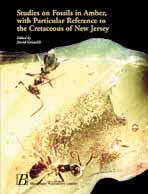 Studies
on Fossils in Amber, with Particular Reference to the Cretaceous
of New Jersey
Studies
on Fossils in Amber, with Particular Reference to the Cretaceous
of New Jersey
edited by David
Grimaldi
2000, approx. 500pp and 17 coloured plates and numerous bl/w
ills.
Hardbound (A4)
ISBN 90-5782-060-9
Dutch Guilders 320.00 / US$ 160.00
Amber, or
fossilized tree resin, has been collected in the Baltic region for
at least 13 millennia, and used as a precious and semi-precious
substance. Now, it is renowned scientifically from various
deposits around the world for its preservation of myriad forms of
ancient life, finer than in any other kind of fossil. The largest
and most popular deposits are the Eocene Baltic amber and Miocene
amber from the Dominican Republic, but amber from the Cretaceous
Period (140-65 million years ago [mya]) is of the greatest
scientific interest.
Besides the extinction of ammonites, dinosaurs, and other life at
the end of the Cretaceous, an explosive radiation of the
angiosperms occurred in the middle of this Period, which
transformed terrestrial ecosystems.
This volume is largely devoted to an extraordinary deposit of
amber, from the Turonian (ca. 90 mya) of New Jersey, USA. The
deposit is not only the most diverse known thus far from the
Cretaceous, but it was formed during the angiosperm radiations.
Research is also presented on amber from the Lower Cretaceous of
Lebanon (120 mya), among the oldest amber in the world that
contains insects. 29 Specialists have contributed 23 papers on
methods for preparation and imaging of amber fossils, paleoecology
of the New Jersey amber deposits, and systematics of over 100
genera and species in 11 orders of animals. Among the discoveries
are the oldest fossil in the phylum Tardigrada, the most diverse
Cretaceous record of scale insects (Coccinea) in the world, a
remarkable diversity of neuropterans, and several groups of biting
midges whose diversity relates to the evolution of vertebrate
blood feeding. These discoveries are presented in nearly 200 pages
of illustrations and photographs, 17 of them in
color.
Dr. David Grimaldi is curator of fossil insects and former Chairman of the Dept. of Entomology at the American Museum of Natural History in New York City. He has published over 100 scientific articles and monographs on the systematics, paleontology, and evolution of insects, including the book, Amber: Window to the Past (New York: Abrams, 1996).
Contents
Preface vii
Overview
David Grimaldi, Alexander Shedrinsky and Thomas P. Wampler.* A
remarkable deposit
of fossiliferous amber from the Upper Cretaceous (Turonian) of New
Jersey 1-76
Methods
David Grimaldi,
Tam Nguyen and Richard Ketcham. Ultra-High-Resolution X-Ray
Computed Tomography (UHR CT) and the study of fossils in amber
77-91
Paul Nascimbene
and Henry Silverstein. The preparation of fragile Cretaceous
ambers
for conservation and study of organismal inclusions
93-102
Systematics
Roberto
Bertolani and David Grimaldi*. A new Eutardigrade (Tardigrada:
Milnesiidae) in
amber from the Upper Cretaceous (Turonian) of New Jersey
103-110
Nina D.
Sinitshenkova*. New Jersey amber mayflies: the first North
American Mesozoic
members of the order (Insecta: Ephemeroptera)
111-125
William L.
Peters and Janice G. Peters*. Discovery of a new genus of
Leptophlebiidae:
Leptophlebiinae (Ephemeroptera) in Cretaceous amber from New
Jersey 127-131
Kumar Krishna
and David Grimaldi*. A new subfamily, genus, and species of
termite
(Isoptera) from New Jersey Cretaceous amber 133-140
Piotr
Wegierek*. A new genus and species of aphid (Hemiptera: Aphidinea)
from New
Jersey amber 141-145
Jan Koteja*.
Scale insects (Homoptera, Coccinea) from Upper Cretaceous New
Jersey
amber 147-229
Viktor B. Golub
and Yuri A. Popov*. A remarkable fossil lace bug from Upper
Cretaceous
New Jersey amber (Heteroptera: Tingoidea, Vianaididae), with some
phylogenetic
commentary 231-239
Vadim G.
Gratshev and Vladimir V. Zherikhin*. The weevils from the Late
Cretaceous
New Jersey amber (Coleoptera: Curculionoidea)
241-254
Vladimir I.
Gusarov*. Mesotachyporus puer, a new genus and species of
Cretaceous
Tachyporinae (Coleoptera, Staphylinidae) from New Jersey amber
255-258
David
Grimaldi*. A diverse fauna of Neuropterodea in amber from the
Cretaceous of
New Jersey 259-303
Hasan
Basibuyuk, Donald L.J. Quicke and Alexandr P. Rasnitsyn*. A new
genus of the
Orussidae (Insecta: Hymenoptera) from Late Cretaceous New Jersey
amber 305-311
Hasan
Basibuyuk, Michael G. Fitton, Alexandr P. Rasnitsyn and Donald
L.J. Quicke*.
Two new genera of the Evaniidae (Insecta: Hymenoptera) from Late
Cretaceous New
Jersey amber 313-325
Alexandr P.
Rasnitsyn*. An extremely primitive aculeate wasp in the Cretaceous
amber
from New Jersey (Vespida: ?Sierolomorphidae)
327-332
James M. Carpenter*. A vespid wasp from New Jersey Cretaceous amber 333-337
Alexander V.
Antropov*. A new digger wasp (Hymenoptera, Sphecidae,
Pemphredoninae)
from New Jersey amber 339-343
Wilfried
Wichard and Annette-Caroline Billing*. Recent knowledge of caddis
flies
(Trichoptera) from Cretaceous amber of New Jersey
345-354
Art Borkent.
Biting midges (Ceratopogonidae: Diptera) from Lower Cretaceous
Lebanese
amber with a discussion of the diversity and patterns found in
other ambers 355-451
Art Borkent*.
Further biting midges (Diptera: Ceratopogonidae) from Upper
Cretaceous
New Jersey amber 453-472
Douglas C.
Currie and David Grimaldi*. A new black fly (Diptera: Simuliidae)
genus
from mid Cretaceous (Turonian) amber of New Jersey
473-485
Taxonomic Index
487
Backhuys Publishers / PO Box 321 / 2300 AH Leiden / The Netherlands / Tel. +31-(0)71-5170208 / Fax. +31-(0)71-5171856 / E-mail: info@backhuys.com
|
|